Duración de la informalidad laboral en México
How long an informal job lasts in Mexico · Undergraduate thesis, ITAM, 2017 · Winner, Premio Citibanamex de Economía 2017 and Premio ExITAM 2018
Undergraduate thesis · ITAM, 2017 · Premio Citibanamex de Economía 2017 · Premio ExITAM 2018
Informal jobs in Mexico end sooner than formal ones in every group studied, but the gap is far from uniform: it widens sharply with education and is more than twice as large among women as among men.
What the thesis does
Using individual labor-history data from the Módulo de Trayectorias Laborales (MOTRAL) 2015, a module INEGI and CONSAR fielded inside the ENOE, I estimate how long a job lasts before it ends, comparing formal and informal employment with survival analysis: Kaplan-Meier estimates of the survival function and Cox proportional-hazards models. The goal is to see which characteristics, gender, age, education, and whether someone’s very first job was informal, are associated with leaving an informal job faster or staying in it longer. MOTRAL covers people aged 18 to 54 with work experience in 32 urban areas. The estimates are urban, not national.
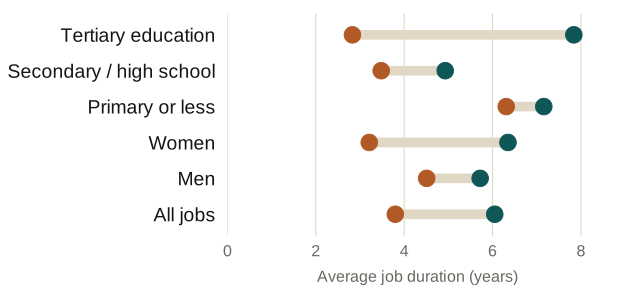
Average estimated job duration, in years, formal versus informal employment. Source: author’s estimates using MOTRAL 2015.
What the thesis finds
A formal job lasts 6.1 years on average, against 3.8 years in informal employment. The gap is wider among women, 49% shorter in informal jobs, than among men, 21% shorter. It also grows with schooling: among people with tertiary education, an informal job lasts 64% less time than a formal one, against only 12% among those with primary school or less. Having started one’s working life in an informal job also raises the risk of losing a later informal job, a sign of how unstable work is for those who stay informal.
Why it matters for policy
Informal employment covers just over half of Mexico’s workforce and limits access to social security, health coverage, and a pension. Understanding how stable an informal job actually is, and for whom it is least stable, helps target job-training programs and early routes into formal employment, in particular for workers with less schooling and for women, where the gap with formal employment is widest.
Full summary
Informal employment covers just over half of all jobs in Mexico and has held roughly steady for decades. This thesis studies how long informal jobs last and how their duration compares with formal employment, using survival analysis on individual labor-history data from the 2015 round of MOTRAL. Formal jobs last longer than informal ones across every group examined, by gender, marital status, age, and education, and informal jobs also face a consistently higher hazard of ending at any point in time. A formal job lasts 6.1 years on average against 3.8 years for an informal one; median durations show a similar pattern. The gap between formal and informal duration is not uniform. It is much wider among women, whose informal jobs last 49% less time than their formal ones, than among men, at 21%. It also grows sharply with education: among workers with tertiary education, informal jobs last 64% less time than formal ones, compared with a 12% gap among workers with primary school or less, consistent with informal work serving more as a stepping stone for the more educated. Having entered the labor market through an informal first job independently raises the hazard of losing a later informal job, pointing to persistence in informal trajectories at the individual level. The thesis argues that policy aimed at reducing informality should account for this heterogeneity: expanding job-training programs and easing early entry into formal employment matters most for workers with less schooling and for women, where the durability gap between formal and informal work is largest.