Health Care Utilization and Costs in Systemic Therapies for Metastatic Melanoma from 2016 to 2020
The Oncologist, 2023
Published · The Oncologist (2023)
With Mollie F. Qian, Nicolas J. Betancourt, Nolan J. Maloney, Kevin A. Nguyen, Sunil A. Reddy, Evan T. Hall, Susan M. Swetter, and Lisa C. Zaba.
Among the four drug regimens used as first treatment for advanced melanoma in the United States between 2016 and 2020, one cost two to three times as much per month as the other three, and the drug itself accounted for most of the difference. The cheapest, nivolumab on its own, was also the most prescribed.
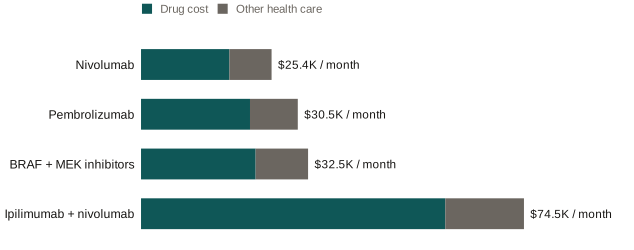
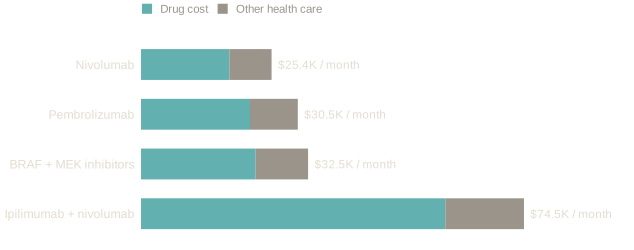
Total health care spending per patient per month, by first-line regimen, 2016–2020, in 2020 dollars. Drug cost is the paper’s “treatment-related cost”; other health care is the remainder. Source: Table 2 of the paper.
What the paper does
Since 2011, new drugs have changed how advanced melanoma is treated. Immunotherapies such as nivolumab and pembrolizumab train the immune system to attack the tumor, and can be combined with ipilimumab, an older immunotherapy. Targeted therapies, BRAF and MEK inhibitors used together, block a specific mutation in the tumor. Survival improved. Costs rose, and no recent study had compared what these regimens cost in practice.
The paper uses insurance claims from Optum, a national database of people with commercial or Medicare Advantage coverage, to follow 2,018 adults with metastatic melanoma who started one of four regimens between 2016 and 2020. For each patient it measures, per month of treatment, hospital stays, emergency visits, outpatient visits, and total health care spending. It then compares the regimens with regression models that adjust for age, other illnesses, brain metastases, type of insurance, and how much care each patient used before starting treatment. I worked on the data analysis and the manuscript with the clinical team.
What it found
Nivolumab alone was the least costly regimen, at about $25,000 per patient per month in total health care spending. After adjustment, pembrolizumab alone cost about $6,500 more per month and the targeted combination about $3,800 more. The immunotherapy combination cost about $47,600 more per month than nivolumab. Its patients also had more hospital days, more emergency visits, and more outpatient visits, which is consistent with the known side effects of ipilimumab. Across regimens, the drugs themselves drove the differences in total cost.
Prescribing also shifted. Nivolumab overtook pembrolizumab in 2018, the year regulators approved giving it every four weeks instead of every two. Fewer infusions mean fewer visits and lower costs, which may explain part of the cost gap. No trial has compared the two drugs directly, though retrospective studies suggest they work about equally well.
How to read it
This is a descriptive comparison built from claims data. It is not a trial. Patients were not assigned to regimens at random: those with brain metastases, for instance, were more often given the immunotherapy combination. The models adjust for that and for other characteristics the data record, but claims do not record tumor mutation status or stage detail, so unobserved differences between groups remain. The sample covers people with commercial or Medicare Advantage coverage, so it is not representative of the whole country. The paper reports where each regimen sits on cost and use of care, given the patients who received it. It does not estimate what would happen if a patient were moved from one regimen to another.