Social Insurance Without a Job: School-Linked Benefits and Early Formalization in Mexico
Working paper, 2026
Working paper · Latest draft August 2026
Delinking health coverage from a formal contract did not push young workers toward informality. It worked as an on-ramp into formal wage employment, and most strongly in the states where informality was highest to begin with.
What the paper does
In 2016 Mexico assigned more than six million public high school and college students a permanent social security number and enrolled each of them individually in IMSS medical coverage, a benefit tied to school enrollment rather than to a formal job. I study the high-school component, comparing birth cohorts still in school at rollout with slightly older cohorts and letting the contrast vary with each state’s pre-policy informality rate. The design recovers how the response scales with initial informality rather than a national average.
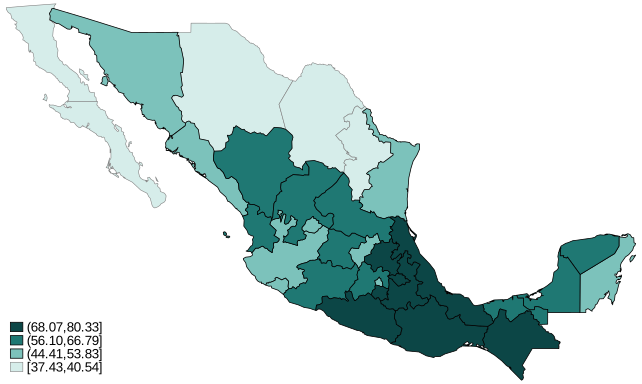
Pre-policy informality rate by state, 2013–2015 average. Own calculation from ENOE microdata (INEGI).
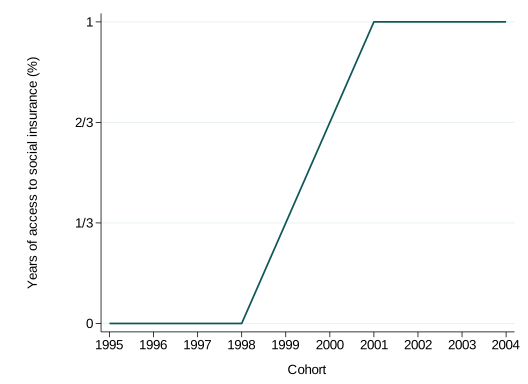
Years of exposure to the reform, by birth cohort.
Why it matters for policy
A standing objection to non-contributory benefits is that they subsidize informality at the margin by lowering the relative value of a formal job. Here the opposite shows up, and the mechanism is administrative rather than financial: the entitlement already existed and schools had long listed their students. What 2016 changed was that coverage was attached to each student as a person, carrying the social security number that formal hiring requires. How a benefit is delivered can matter more than whether it is contributory.
An explainer version of this paper walks through the same result for a general audience, including a plain-language walkthrough of the Rambachan and Roth (2023) sensitivity analysis, which measures how far the identifying assumption would have to fail before the result goes away.
Full abstract
In 2016 Mexico assigned more than six million public high school and college students a permanent social security number and registered each of them individually for national social insurance (IMSS) medical coverage, a benefit tied to school enrollment rather than to a formal job. A long-standing objection to such policies is that benefits delinked from formal contracts reduce the relative value of a formal job and subsidize informality at the margin. I study the high-school component, comparing birth cohorts still in school at rollout with slightly older cohorts and letting the contrast vary with each state’s pre-policy informality rate; the design recovers how the response scales with initial informality rather than a national average. Where informality was initially higher, precisely where the subsidy concern is sharpest, exposed cohorts pulled further ahead of adjacent unexposed cohorts in formal employment, and informal employment fell rather than rose. The response is concentrated entirely in wage employment and absent in self-employment. Delinking did not tilt young workers toward informality. The entitlement predated the reform, and schools had long listed their students; what 2016 changed was that coverage was attached to each student as a person, with the social security number that formal hiring requires, and made salient. Delivered that way, a benefit outside a formal contract worked as an on-ramp to formal employment rather than as a substitute for it.